

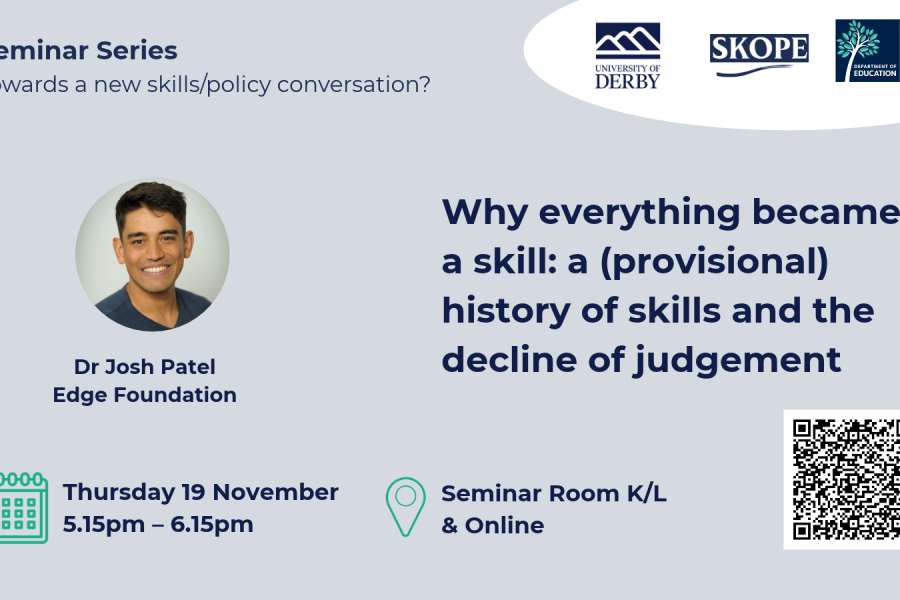
‘Skills’ have become the prevailing organising paradigm of education and skills in the UK. ‘Shortages’, ‘gaps’, and ‘deficits’ are identified relative to specific targets like building 1.5 million homes by 2029, or to projected national need in ‘high growth areas’ in 2035. Persistent criticism of the reductive quality of skills and their estrangement from the whole person has failed to arrest ‘skills’ ascendency.
Rather than criticising skills as a category, this talk aims to provide an explanation of why the paradigm has prevailed despite its flaws. It will sketch a possible trajectory of the emergence of ‘skills’ from the post-war period to today. Skills emerged following the ‘decline of deference’ to a liberally educated elite whose judgement and leadership was, prior to the 1960s, sufficient to justify huge redistributions of public wealth. During the crises of the 1970s, policy increasingly favoured centralised, technocratic instruments over negotiation between leaders representing different interests, such as employers or trade unions. These novel forms of accountability did not rely on subjective judgment but on modes derived from deductive economic science. As trust in numbers has grown, they have moved from rough manpower planning on the level of labour markets to fixed, defined personal capacities: ‘skills’.
The deeper deficit lies in a political system that now struggles to produce compelling holistic judgments of long-term public value. The turn to skills is best understood as a consequence of this erosion, rather than as its origin.
Josh Patel is a Senior Education and Policy Researcher at the Edge Foundation, and previously a fellow at the University of Warwick. He is the author of Universities and the purpose of higher education: expansion and development in post-war Britain (2026), and curates Edge series including Learning from the Past and their Skills Shortages Bulletins.